AGAinst erasure:
A History of us
A History of Coptic Nashville:
When I first tried to undergo this project as an undergraduate, I ended up writing a thesis that was over 100 pages long, unruly and yet still not fully encompassing the beauty of Coptic history, identity-making, and legacy in Nashville. So, this to say: bear with me.
Copts–Egyptian Christians–trickled into Nashville in the 1980s to work as engineers and doctors mostly through Vanderbilt University. This small group gathered weekly in one member’s house for dinner and quiet communal prayers, and then monthly, they’d pay for a priest to fly up from Florida to Tennessee to pray liturgy and partake in the Eucharist (communion). It was just a few families–only six or so.
In 1993, the Patriarchate of Alexandria created the Diocese of the Southern United States, which held everything south of Washington, DC/Maryland and west until California. Even today, even with the Carolinas and Kentucky becoming their own diocese in 2016, the Southern Diocese is the largest in the Coptic Orthodox Church. Nashville is part of the Southern Diocese, but in 1993, it was still a very small gathering of dedicated families.
In 1994, there was a massive shift, and this shift can only be understood in the context of labor history in Nashville.
Nashville, as many may or may not know, is one of the seats of the Civil Rights Movement. The Reverend Martin Luther King Jr., who visited Nashville many times to encourage the student protests, said in April 1960
that “the movement here is the best organized and best disciplined of all the movements in the Southland today.” He called the sit-in protestors “an inspiration” to the nation. Out of Nashville came the great NAACP attorney Alexander Looby, whose house was bombed by white supremacists, and also figures like John Lewis, Diane Nash, Reverend James Lawson (who lost his job at Vanderbilt University for his activism), and Bernard Lafayette.
In retaliation to the immense presence of the Civil Rights leadership and movement, the state of Tennessee broke up Black communities. What was once a majority Black city, through concerted efforts, in the 1970s and 1980s became a white haven. Policies like establishing a metropolitan government between a predominantly-Black city and preodimanntly-white suburb meant that taxes were leaving the city to the suburbs; policies like the construction of Interstate 40 ripped through Jefferson Street, a Black Wall Street in the South.
But in all things, when working class communities are attacked and drained of resources, recessions follow. Nashville, through the 1980s and early 1990s, took a massive hit to the state’s attack on Black communities. Always known to be a city with a small town feel, Nashville corporations began to welcome immigrants and refugees, not as neighbors, but as workers to help rebuild what was destroyed.
Many white residents in Nashville will tell you that the 1980s/1990s–when Nashville was small–was a romantic time with the Opryland amusement park and no traffic and no burgeoning skyscape; just a few bungalow-style homes, quiet streets, and quaint commercial centers on main roads. But what this narrative does not disclose is a very sinister reality in the background of that dream: the corporate hold over Nashville.
In 1994, Gaylord Opryland, a hotel and amusement park right on the Cumberland River, needed workers. They needed a new business plan. A Coptic man working there, George Hanna, said he knew where they could source workers, and he contacted a church in New Jersey–a hub of Coptic migration. It’s unclear who sent the bus to Bayonne to come down to Nashville–whether Opryland or Hanna paid for it–but what we know is that hundreds of Coptic families came down to the South, were put in a place called Millwood off Mill Creek, and were drafted to work at Opryland. Within a decade of Coptic presence in Opryland, the white owners shut down the amusement park, renovated the hotel to become a luxury hotel, and were now a booming business.
This moment heralded the resurrection of Music City, forever tying Coptic labor to a city that needed a new source of workers. In the coming years, between 1994 and 2010, Coptic workers built not just Opryland, but also the nearby airport, which, in the 1990s, was a small and dingy, had become an international portal in 1994. Coptic workers also staffed multiple major hotels downtown like the Loew’s and Sheraton and Hilton, building up the downtown hospitality industry, which Nashville would become famous for in the coming years with bachelorette parties and conferences selecting Nashville as a destination now.
There is a lot that can be said about Coptic labor and how Copts organized effectively and ineffectively during these times to raise wages and benefits, and I want to make sure that that is noted. I do not write this history from a perspective of Copts as victims, but I do write with the acknowledgment of exploitation of Coptic labor, narrative, and presence from the rich in Nashville, and I also write from the perspective that, though exploited, Copts have carried multiple feats in Nashville that also go unrecognized.
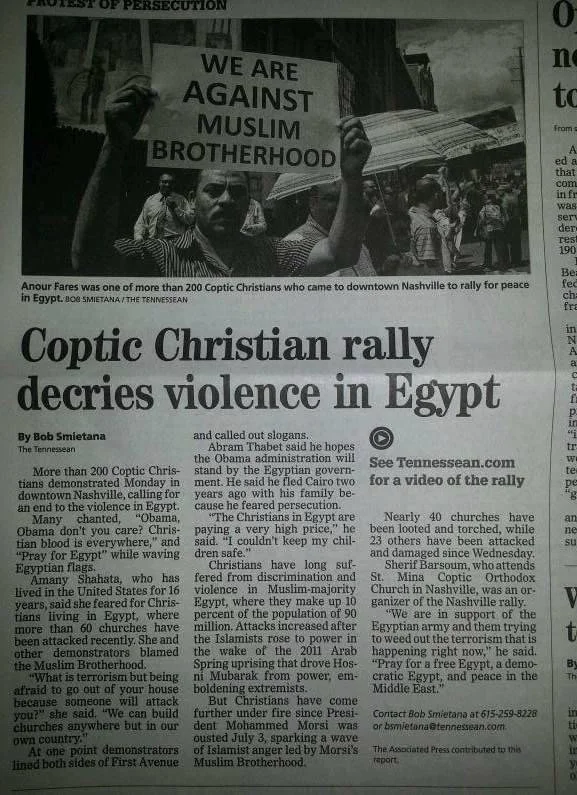
On January 6th, 2010, a terrorist bombed a Coptic Orthodox church during Nativity liturgical prayers in Nag Hammadi, Egypt. Several Copts from Nashville are from the South of Egypt where they experienced discrimination and persecution, though are not granted refugee or asylum status in the United States. (Most Copts in Nashville in the 1990s and early 2000s were lottery visa holders or sponsorship visa holders.) This bombing had a major impact on Nashville and workers left their shift to protest in downtown Nashville with crowds of hundreds of workers demanding justice.
In May of 2010, though, Nashville flooded, and Millwood, which sits right on Mill Creek, drowned. Copts, who had lived alongside Somali and Ethiopian workers in Millwood to staff Opryland, the airport, and hotels, were officially displaced, abandoned by Metro government during aid and support. This permanent displacement from Millwood changed a lot for Copts who, as workers, used to live in the same area, shop in the same area, go to church in the same area, go to work together. Displacement scattered the thousands into Antioch (further southeast of the airport), while businesses remained in Millwood to this day as I write this. Latino and Caribbean community members moved into Millwood after this exodus, so that Millwood, a symbol and the material result of resistance, stands between the airport and downtown with Egyptian/Somali/Ethiopian businesses with Latino/Carribean residents against all odds to government efforts to attack and displace residents and gentrify a key part of the city: new luxury apartments stand out at the gates of Millwood, roaring to be let into the enclave, while drug distribution efforts are continually pushed on the community and fail. Today, Elon Musk’s Boring Company is fighting tooth and nail to take that area over to build his Tesla Tunnel, and Metro government, refusing to support the community’s bus line or offer any resources, has left the people to their own.
The displacement into Antioch did not stop the protests. In January 2011, when the Egyptian revolution happened, Coptic workers again left their shifts to protest Hosni Mubarak’s regime. But alongside the housing displacement, even with the fervor of a tightly-knit community of old, the Coptic community was changing. Before, the hundreds of Copts who had come from New Jersey to Tennessee, had been destined to New Jersey first, but now, Copts knew to come straight to Nashville, that they would find work here.
This era was not only different in that the community was growing larger and larger, but also in the type of jobs. With the major housing displacement, factories started popping up: Asurion, Sinemax, Heartland, Ingram Publishing, Tyson. Copts, coming straight from Egypt and needing immediate work near Antioch, began to work at factories near Antioch/LaVergne/Smyrna. Amazon made its second headquarters in Nashville and opened up warehouses in the surrounding Nashville area, which Copts also staffed; FedEx’s headquarters become Memphis, but they opened up warehouses in Wilson County, which Copts also staffed.
These new employers changed the culture of the community here drastically. First, Copts who worked at factories did not work with any English-speaking guests or clients, so those workers became slower to learn English and to accumulate to the culture in Nashville, which meant that the community at-large became more isolated, more tied to to employers and less as neighbors. Second, Copts had so many options to work, so it was easy for some to leave one employer for the next and use higher wages elsewhere to extract from the other; the race for Coptic labor in Nashville began, with employers attempting to cater each warehouse or factory to Coptic standards–whether that be vegan snacks during Lent or Advent, or playing Egyptian music on blast during factory hours, or hiring bilingual middle staff (for HR and shift leads), or donating to Coptic churches. In other words, employers were good at seemingly alluding to the option of choice.
But what happened, in reality, was that no more protests happened. No more union-like efforts happened. No more collective bargaining and push for human rights and dignity happened. And a community that was once pushing for its visibility and collective bargaining as one of the largest immigrant communities in Nashville fell aside under the abstract that there was choice.
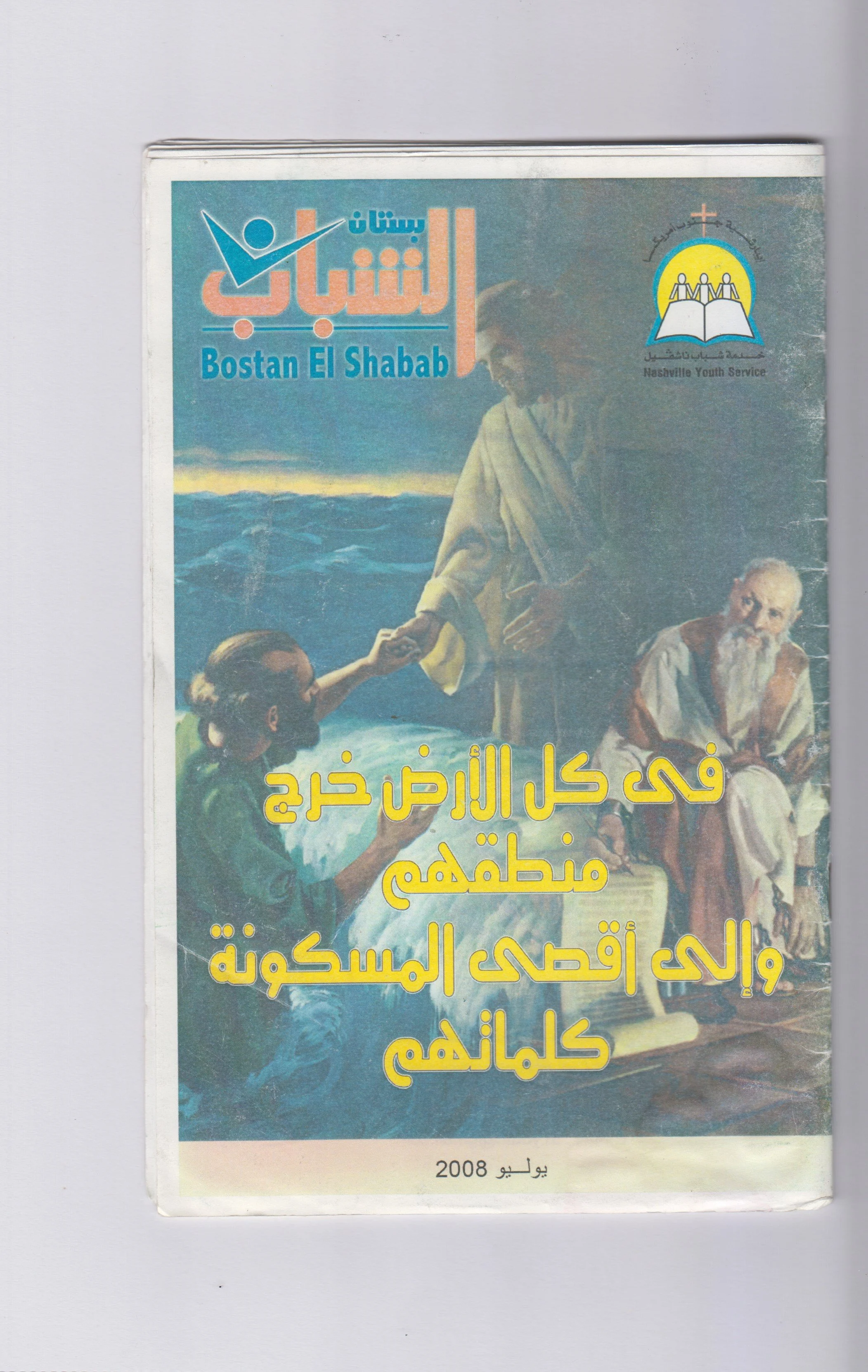
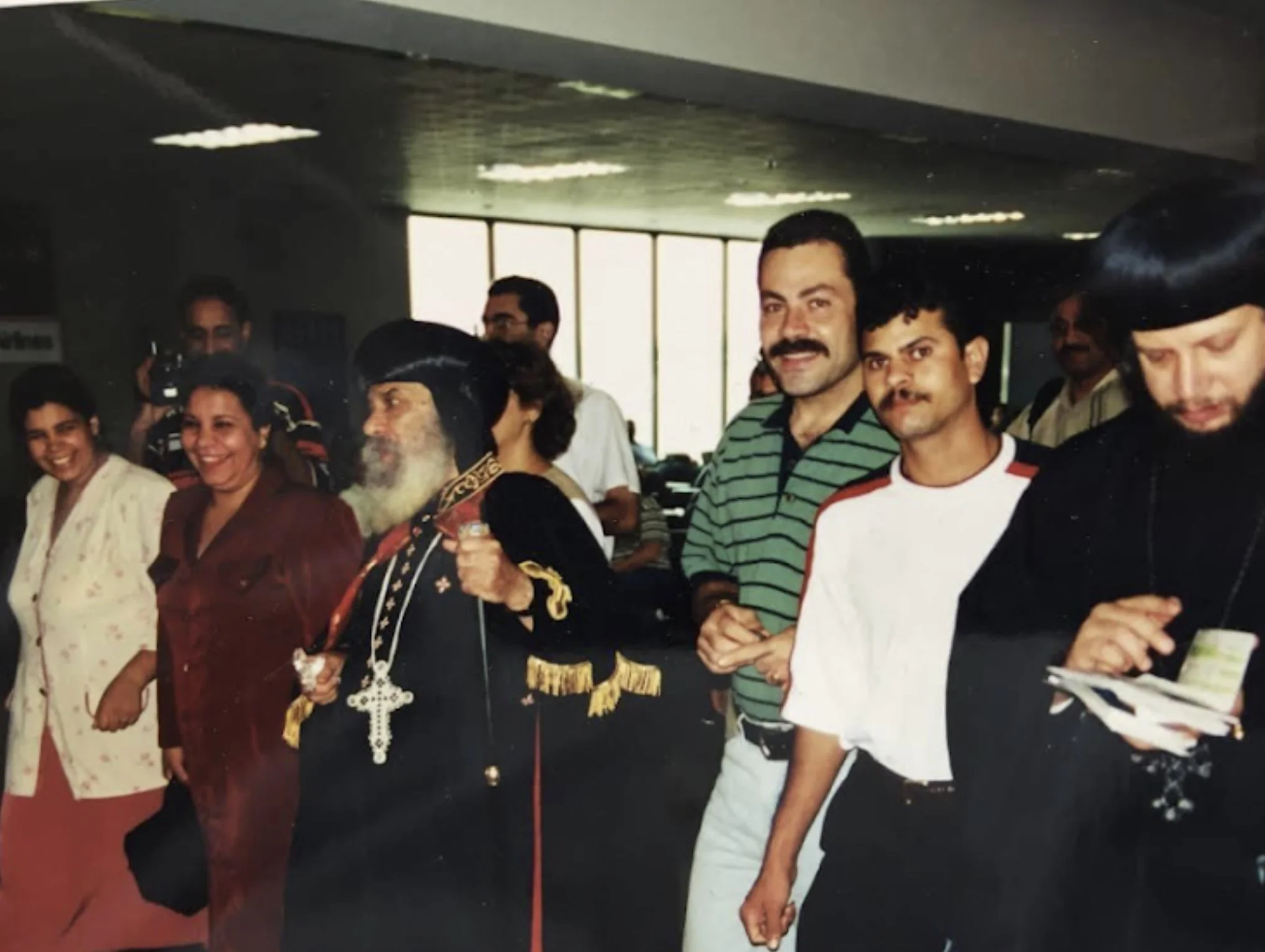
There is so much to continue to say–whether that be about the creation of the Tennessee Arab Newspaper around 2011, the legacy of Abouna Mina Iskander and the dream for newcomer orientation and support, the inception of Elmahaba in 2019, the visitations of two Patriarchs to Nashville (see timeline), the 20 Coptic Orthodox churches and 1 Coptic Catholic and 10 Coptic Protestant churches in the greater Nashville area, the numerous Coptic valedictorians and salutorians, the hundreds of thriving Coptic-owned small businesses throughout the whole city (particularly in liquor stores, gas stations, grocery stores/bakeries).
It’s hard to capture the beauty we see here–the excellent Egyptian pita bread from Gold Star, the vegan fateer bread from Sam’s bakery, the exchange of Eid cookies continually, the Coptic homes with molokhiya stalks in the backyard and the fresh mint in the front lawn, the mutual aid Facebook pages and networks, the dozens of Toyotas in the church parking lot and the multiple liturgies on Sundays to accommodate the hundreds, the whispering of Arabic in the malls in the suburbs even, the familiar Coptic face everywhere in this city as servers, musicians, baristas, housekeeping, taxi drivers, daycare professionals, doctors, real estate agents, landscapers, jewelers.
Today, the Coptic community is splintered and, like other communities, is being displaced out of Davidson County/Nashville actively. Copts live on the outskirts mostly, fueling the city core (the hospitality industry) and also the state’s bundle (the factories and warehouses).
This story is ongoing; it still breathes. I have faith that Coptic people, in solidarity with all workers, will find ourselves again, and that’s why I tell this story–even with a tight relationship between the church and corporations, and an even tighter embrace between Metro Nashville government and corporations. I tell it because there is still time, and there are still people willing to fight.
This year, I sat down with an elder in the community who worked downtown in the 90s, who led protests in 2010 and 2011. I told him about the art events we have going on at Elmahaba Center in 2026, and his eyes, in a daze, distant, said, “It was always a dream: to bring everyone together; to sit and drink coffee; to read poetry.
It has always been my honor to witness, to serve, to live among one of the resilient peoples. You all, in the history we are making together, have made this life worthy of each breath.
May we, as creators, continue to see ourselves everywhere, in everyone, in everything that we have given life to and what is still to come in this city.
Lydia Yousief
March 27, 2026